COURSE
Agentic Engineering 101
Be the GOAT… or farm the goats. A free course on building software with many AI agents. Elon Musk replied to the launch video: “Good one.”
Sign up for free
Agentic engineering is building software by directing AI coding agents instead of writing the code yourself. The engineer decides what to build, splits the work into tracks, defines what done means and reviews what gets merged. The agents write the code, test it and review each other's pull requests.
Andrej Karpathy proposed the name on February 4, 2026, a year after he coined "vibe coding", to separate professional work with agents from throwaway experiments. "Agentic", because most of the time you orchestrate agents and act as oversight. "Engineering", because it is expertise you can learn and get better at. His goal: the gains agents bring "without any compromise on the quality of the software."
Agents do not remove judgment: once they do the typing, human attention is the scarce resource.
At The Agile Monkeys, an AI engineering studio, we teach it in Agentic Engineering 101, a free English course that opened on October 30, 2026. Eleven modules go from one agent used well to twenty sessions in parallel.
Module 00 plays the whole game in 45 minutes: plan, build, parallelize and review a real change.
Be the GOAT… or farm the goats. A free course on building software with many AI agents. Elon Musk replied to the launch video: “Good one.”
Sign up for free
Get more out of Codex and Claude Code with bigger goals, thinking out loud, connected context, and a daily workflow that frees up attention.
Read
Once agents write the code, what is left is what the job always was: solving the problem with what is available, and knowing the constraints.
Read
Writing and reviewing code lose value. Problem solving, our own tooling and knowing the rules of the game gain it.
ReadA native macOS console for herding your coding agents across Herdr machines
View the repository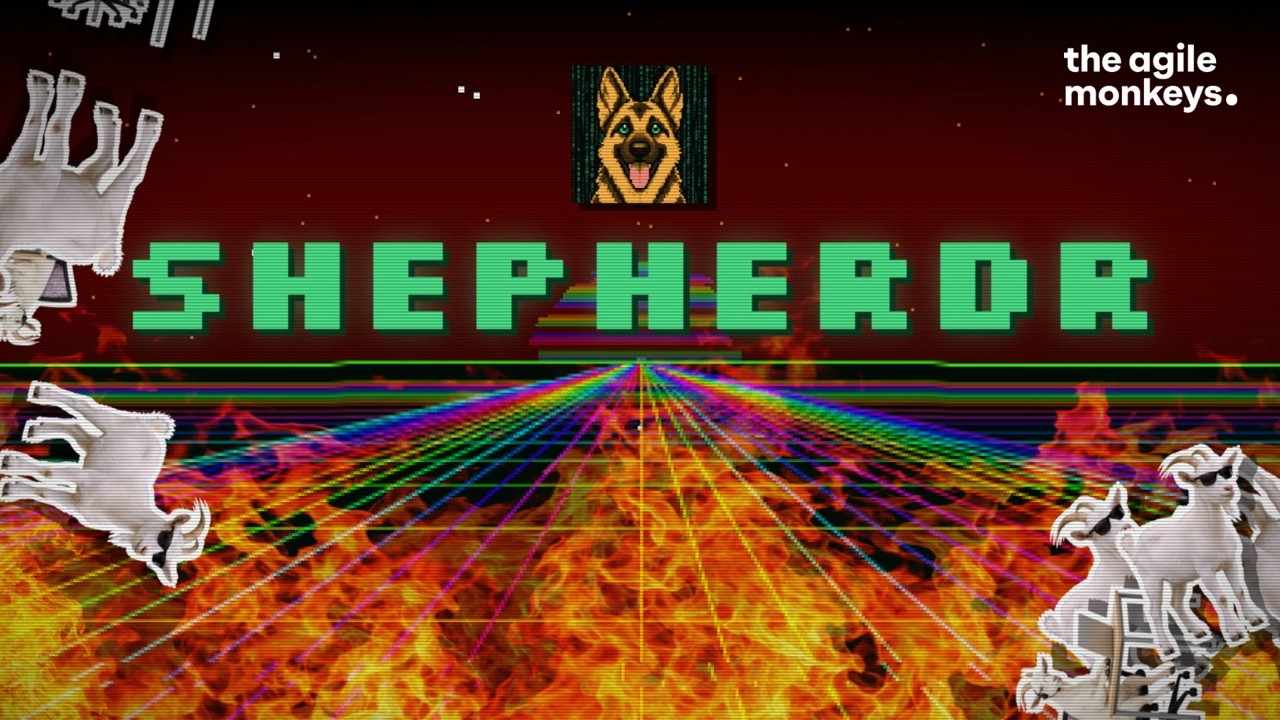
A native macOS console for herding your coding agents, on every machine you run, in one queue. Free and open source (MIT). Claude Code, Codex, Gemini, opencode and friends in one prioritized queue: the real terminal, a browser per agent, agents that spawn agents on other machines, and Compass, which reads your day so you don't have to. It runs on Herdr and was built mostly by agents. Code: https://github.com/theam/shepherdr
ViewOpen-source, stack-agnostic issue-to-PR workflow plugin for Claude Code: quality gates, tracker & PR-host adapters, opt-in anonymous telemetry.
View the repositoryConversations from inside the team, in Spanish.
Open Kitchen lets you into our internal meetings: no script, only what was actually said. In #1, Javier Toledo (CTO), Álvaro López (Lead Dev), Jaime López (CEO) and Adrián Lorenzo (CRO) ask what the engineer brings once AI writes the code. In Spanish, with English subtitles.
ViewIf AI already writes good code, what is left for the engineer? Flavia Marsano, AI Lead, asks Adrián Lorenzo (CRO) and Álvaro López Espinosa what they see for the engineer's role over the next five years. In Spanish.
ViewWhich skills does an engineer need once AI writes and reviews the code? Adrián Lorenzo and Álvaro López answer. In Spanish.
View